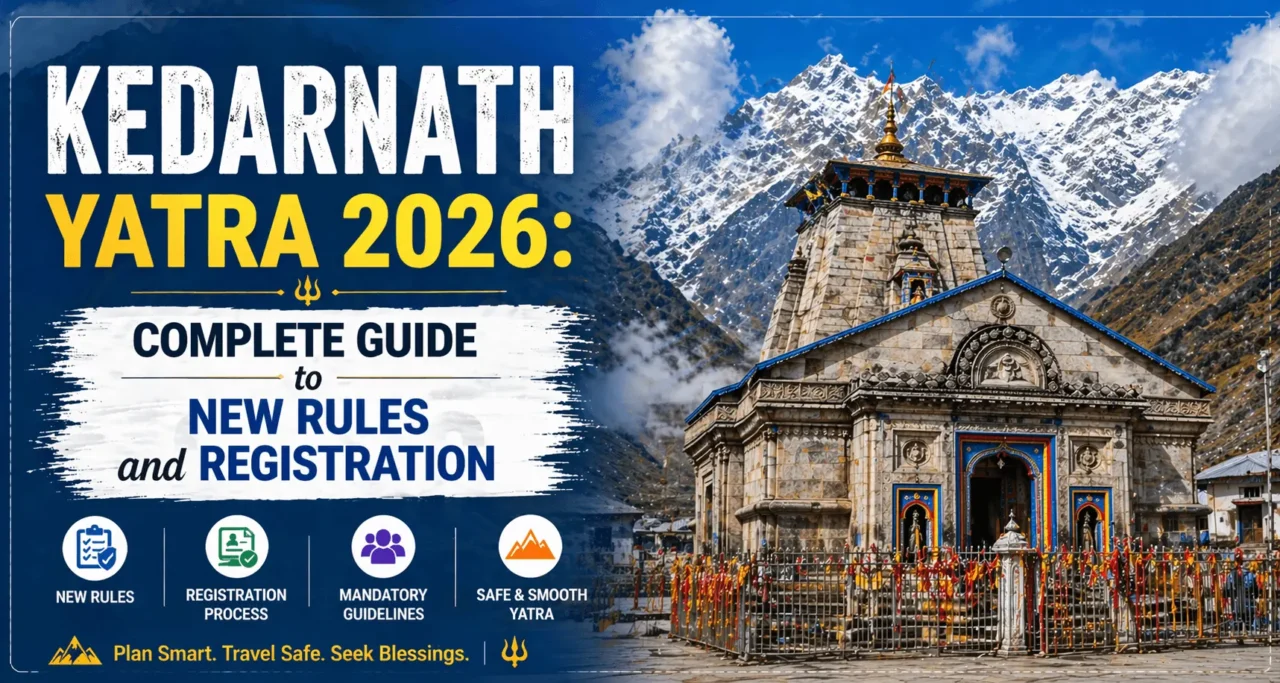
The Kedarnath Yatra 2026 new rules have changed the pilgrimage experience in ways every devotee must understand before leaving home. Registration is now stricter, mobile phones are banned inside the temple, RFID-based QR passes are scanned at multiple checkpoints, and daily entry is capped at around 18,000 pilgrims. Miss any of these steps and you will be turned back at Sonprayag — no exceptions.
The kapat (temple doors) of Kedarnath Dham opened on 22 April 2026 at 8:00 AM, continuing the sacred Char Dham Yatra 2026 season. With over 19 lakh pilgrims having pre-registered even before the opening day, this is the most in-demand Yatra season in recent memory. This guide covers every rule, every step, and every insider tip so your journey to the abode of Lord Shiva is safe, smooth, and spiritually fulfilling.
What’s New in Kedarnath Yatra 2026? Key Changes You Must Know
The Badrinath-Kedarnath Temple Committee (BKTC) and the Uttarakhand government have introduced several important updates for the 2026 season. These are not suggestions — they are enforceable rules, and violations can result in denied entry or removal from the premises.
Here is a summary of the biggest Kedarnath new rules in 2026:
Mobile phones and cameras are completely banned inside the Kedarnath Temple complex. This includes photography, video recording, Instagram Reels, live streaming, and drone flights. Secure cloakrooms are provided outside the temple gate, where you must deposit your device before entering.
Non-Hindu pilgrims must submit a signed affidavit affirming their faith in Sanatan Dharma to gain entry into the main shrine. This rule applies to all 47 temples managed by the BKTC. Sikhs, Jains, and Buddhists are exempt from this requirement.
A QR-coded Yatra registration e-pass is mandatory at every checkpoint — at Sonprayag, Gaurikund, and at the temple entrance itself. If you do not have this pass, you will not proceed beyond Sonprayag, regardless of any other booking you hold.
Night travel is banned on mountain roads between 10:00 PM and 4:00 AM. Plan overnight stops accordingly.
Expert Note: The 2026 rules are stricter than any previous year, introduced after the record-breaking pilgrim inflow of 2023–2025. The Uttarakhand government has also deployed 177 ambulances along the route and stationed NDRF (National Disaster Response Force) teams at key points — a major upgrade in safety infrastructure.
Kedarnath RFID Registration 2026: Step-by-Step Process
Every pilgrim — whether you are trekking on foot, riding a pony, travelling by palki (palanquin), or flying by helicopter — must complete the Kedarnath RFID registration 2026 before setting out. The registration is completely free of cost. Avoid any agent or website charging a fee for this.
The official registration website is registrationandtouristcare.uk.gov.in. Registration for the 2026 season opened on 6 March 2026.
Step 1: Visit registrationandtouristcare.uk.gov.in or download the Tourist Care Uttarakhand app on Android or iOS.
Step 2: Click “Register/Login” and create an account using your mobile number and email address. Verify via OTP.
Step 3: Log in and select “Create/Manage Tour Info.” Choose “Char Dham Yatra 2026” and select Kedarnath as your destination.
Step 4: Enter details for each pilgrim in your group — full name, age, gender, and home address. Upload a passport-size photograph and a valid government ID (Aadhaar card, Voter ID, or Passport for NRIs).
Step 5: Submit to generate your QR-coded Yatra e-pass. Download it and print a hard copy as backup.
You can also register via WhatsApp by sending the word “Yatra” to +91-83948 33833 — the official bot will guide you through the process in under two minutes. This is often faster than the website during peak registration periods.
Offline registration is available at designated counters in Haridwar, Rishikesh, Sonprayag, Guptkashi, and Dehradun Airport. Carry original ID proof and a passport photo. Expect long queues during peak months.
Pro Tip: Register as early as possible. Daily entry is capped at approximately 18,000 pilgrims. During May–June peak season, slots fill up within hours. Families travelling with elderly parents or children should lock in their dates at least 3–4 weeks in advance.
Kedarnath Yatra Guidelines 2026: The Complete Rulebook
Understanding the full set of Kedarnath yatra guidelines 2026 will save you from unpleasant surprises on the route. Here is every rule that currently applies.
Mobile Phone and Camera Ban
As mentioned above, no mobile phones, cameras, or any electronic recording devices are permitted inside the Kedarnath Temple premises. This rule is being enforced rigorously by security personnel stationed at the temple gate. Anyone caught violating this rule may face penalties or legal action. Leave your phone at the cloakroom, take a breath, and experience darshan (sacred viewing) the way it was always meant to be — undistracted.
Non-Hindu Entry Rules
The BKTC now requires non-Hindus to submit a written and signed Sanatan Dharma affidavit to enter the main sanctum. Without this document, entry to the inner shrine will be restricted. Sikhs, Jains, and Buddhists are exempt. This rule applies uniformly across all 47 temples under BKTC management.
Night Travel Restrictions and Vehicle Rules
Mountain road travel is restricted between 10:00 PM and 4:00 AM. All vehicles must pass technical inspections before entering the pilgrimage corridor. If your vehicle is registered outside Uttarakhand (for example, Delhi, Haryana, or UP plates), you must obtain a Green Card (Trip Card) permit from greencard.uk.gov.in before entering. Failure to carry this permit means you will be stopped at the Haridwar or Rishikesh border checkpost.
Daily Darshan Capacity Limit
A maximum of approximately 18,000 pilgrims per day are allowed to proceed toward Kedarnath. Your registration e-pass includes a dated slot, and you must travel on or close to your selected date. Darshan is organised in time slots to prevent congestion at the temple.
Kedarnath Health Certificate and Age Limit: Who Needs What
Kedarnath sits at an altitude of 3,583 metres (11,755 feet) above sea level. The trek from Gaurikund is 16 to 18 km uphill, with stretches reaching well above 10,000 feet. High altitude affects everyone differently, and the government has introduced medical screening measures to prevent tragedies on the trail.
A formal medical fitness certificate (Kedarnath health certificate) is not mandatory for all pilgrims, but it is strongly recommended for anyone above the age of 50. For pilgrims above 55 years, especially those with asthma, diabetes, heart conditions, or high blood pressure, health advisories have been issued recommending a pre-travel medical check-up from your doctor.
At the Sonprayag checkpoint, authorities conduct on-the-spot health screening. They check your SpO2 (blood oxygen level) and blood pressure. If your SpO2 reading falls below 85–90%, you will legally not be allowed to continue the trek, regardless of your registration status or travel plans.
There is no official minimum or maximum age limit for Kedarnath Yatra, but common sense applies. Infants and very young children may struggle with altitude sickness. Senior citizens above 70 years with pre-existing conditions are strongly advised to consider the helicopter option or consult their physician before attempting the trek.
Pro Tip: Acclimatise for at least one night in Rishikesh or Haridwar before beginning the Yatra. Drink 3–4 litres of water daily. Avoid alcohol and sleeping pills at altitude. If you feel breathless, dizzy, or nauseous, stop and rest immediately — do not push through.
Kedarnath Dress Code: What to Wear on the Yatra
There is no strictly enforced official dress code at Kedarnath in the way some temples have one, but the Kedarnath dress code expectations are rooted in tradition and practical necessity.
For temple darshan: Modest, traditional Indian clothing is strongly preferred and culturally expected. Men wearing dhoti-kurta, salwar-kurta, or clean jeans with a simple top are welcomed. Women wearing sarees, salwar-kameez, or anarkali suits are most appropriate. Revealing clothing, shorts, sleeveless tops, or miniskirts are considered disrespectful and you may be requested to change before entering.
For the trek: The weather at 3,583 metres is unpredictable even in May. Pack thermal inners, a fleece jacket, a waterproof windcheater, and sturdy trekking shoes with grip. Temperatures can drop to 5–10°C even in summer months and near zero at night.
Carry a woollen cap, gloves, and a light scarf. Synthetic or moisture-wicking fabrics are better than cotton for the trek. Flip-flops and sandals are not suitable beyond Gaurikund.
Kedarnath Yatra Permit: Helicopter Booking and Darshan Parchi
Apart from your registration e-pass, there are two more “permits” relevant to the 2026 Yatra.
VIP Darshan Parchi
For priority darshan inside the temple, the official VIP Darshan receipt (parchi) costs approximately ₹1,100 per person. This is issued at the temple counter and allows you a faster queue for a close darshan of the Shivalinga. During peak May–June rush, the temple committee may suspend VIP entries entirely and all darshan becomes general.
Do not pay any pandit or agent offering “backdoor entry” for ₹2,000–5,000. This is a scam. You may be caught and denied entry entirely.
Kedarnath Helicopter Booking 2026
For pilgrims who cannot do the 16–18 km trek — including the elderly, the differently abled, and families with young children — helicopter services are the practical and safe option. The Uttarakhand government has authorised up to eight helicopter companies to operate for the 2026 season.
The ONLY official platform for helicopter booking is heliyatra.irctc.co.in. Any other website claiming to offer Kedarnath helicopter bookings is fake and likely a scam.
IRCTC releases helicopter tickets in batches, typically opening slots 4 to 6 days before the travel date at 12:00 PM noon. Tickets vanish within 10 minutes during peak season. Be online and ready exactly at noon on booking day.
Current 2026 helicopter fare estimates (round trip):
| Helipad | Flight Duration | Approx Fare (Round Trip) |
|---|---|---|
| Phata | ~7 minutes | ₹10,164 |
| Guptkashi | ~10 minutes | ₹12,762 |
| Sirsi | ~6 minutes | ₹6,390 (one way) |
Prices are subject to change based on operator and season. Always confirm on heliyatra.irctc.co.in.
Note that your Yatra registration e-pass is mandatory even if you book a helicopter. You cannot book a helicopter ticket without a valid registration Group ID.
Char Dham 2026 New Rules: How Kedarnath Fits Into the Bigger Picture
The Kedarnath pilgrimage is part of the famous Char Dham Yatra 2026 — the sacred circuit of four Himalayan shrines. If you are planning the full Char Dham Yatra, here is the 2026 opening sequence you need to plan around:
| Dham | Opening Date (2026) | Road Accessible? |
|---|---|---|
| Yamunotri | 19 April 2026 | No — 5–6 km trek from Janki Chatti |
| Gangotri | 19 April 2026 | Yes — direct road access |
| Kedarnath | 22 April 2026 | No — 16–18 km trek from Gaurikund |
| Badrinath | 23 April 2026 | Yes — direct road access |
The char dham 2026 new rules apply uniformly across all four shrines: mandatory registration, mobile ban inside temples, timed darshan slots, and vehicle permits for out-of-state cars. The full Char Dham Yatra typically takes 10 to 12 days starting from Rishikesh or Haridwar.
Expert Note: If you are only visiting Kedarnath and not the full Char Dham, budget at least 4 to 5 days — two days of travel from Delhi or Mumbai, one day for the trek up and darshan, one day to descend, and one buffer day for weather delays. Never plan a same-day trek and return.
The standard route from Delhi is: Delhi → Haridwar → Rishikesh → Guptkashi → Sonprayag → Gaurikund → Kedarnath (trek).
Kedarnath Yatra Do’s and Don’ts: A Practical Pilgrim Guide
Following the Kedarnath yatra do’s and don’ts will ensure your journey is not just spiritually meaningful but also safe.
Do’s: Carry both a digital and printed copy of your QR-coded e-pass. Register early and on the official portal only. Acclimatise before the trek. Carry cash — ATMs are limited at Gaurikund and non-existent on the trek. Use BSNL SIM for network on the trek route (Rambara to Lincholi); Jio has 4G near the temple but goes dead on the trail. Carry reusable water bottles and personal medicines. Inform a family member of your complete itinerary.
Don’ts: Do not book helicopter tickets on any website other than heliyatra.irctc.co.in. Do not pay anyone for registration (it is free). Do not carry your phone inside the temple. Do not trek after dark or in bad weather. Do not ignore health screening at Sonprayag — it is there to protect you. Do not litter on the trail. Do not attempt the trek without proper footwear.
Latest Kedarnath Yatra 2026 Updates: Infrastructure and Safety
Based on official Uttarakhand Tourism data and announcements from Uttarakhand Chief Minister Pushkar Singh Dhami, here are the significant infrastructure improvements made for the 2026 season:
177 ambulances have been deployed along the Char Dham route, with dedicated medical camps at regular intervals on the Gaurikund-Kedarnath trail. A helicopter ambulance operated by AIIMS Rishikesh is stationed for emergency medical evacuation — a significant addition over previous years.
NDRF teams are stationed along the route for rescue operations during weather events. The path surface between Gaurikund and Lincholi has been improved, making it safer for elderly pilgrims and those using ponies or palanquins. Security deployments have been strengthened at all major checkpoints.
For the most current Kedarnath yatra latest news — including trail conditions, daily pilgrim count, and weather alerts — follow the official channels of the BKTC and check uttarakhandtourism.gov.in regularly. The season runs until Bhai Dooj on 11 November 2026, when the kapat close for winter and the Utsav Murti of Lord Kedarnath is moved to Omkareshwar Temple at Ukhimath.
Frequently Asked Questions About Kedarnath Yatra 2026 New Rules
Q: What are the major new rules for Kedarnath Yatra 2026?
A: The key Kedarnath Yatra 2026 new rules are: mandatory QR-coded registration (free, at registrationandtouristcare.uk.gov.in), a complete mobile phone and camera ban inside the temple, non-Hindu entry restricted without a signed Sanatan affidavit, night travel banned 10 PM–4 AM, and a daily pilgrim cap of approximately 18,000 persons. All these are strictly enforced.
Q: Is Kedarnath RFID registration 2026 free? How do I register?
A: Yes, Kedarnath RFID registration 2026 is completely free. Visit registrationandtouristcare.uk.gov.in or the Tourist Care Uttarakhand app, create an account, select Kedarnath, upload your Aadhaar/Passport photo and ID, and download your QR-coded e-pass. You can also register via WhatsApp by sending “Yatra” to +91-83948 33833.
Q: Is a health certificate mandatory for Kedarnath Yatra 2026?
A: A formal Kedarnath health certificate is not mandatory for all pilgrims but is strongly recommended for those above 55 years or with conditions like diabetes, asthma, or heart disease. Authorities conduct on-the-spot SpO2 and BP checks at Sonprayag. If your blood oxygen falls below 85–90%, you will not be allowed to proceed on the trek.
Q: What is the age limit for Kedarnath Yatra 2026?
A: There is no official minimum or maximum Kedarnath age limit for the Yatra. However, very young children and elderly pilgrims with health conditions should consider the helicopter option. All individuals, including children, must be registered on the official portal individually.
Q: What is the dress code for Kedarnath?
A: There is no strictly enforced Kedarnath dress code, but modest, traditional Indian clothing is culturally expected inside the temple — no shorts, sleeveless tops, or revealing clothing. For the trek, dress in warm, layered clothing: thermals, fleece, waterproof jacket, and sturdy trekking shoes. Temperatures can drop to 5°C even in summer.
Q: How do I book a Kedarnath helicopter ticket in 2026?
A: The only official platform is heliyatra.irctc.co.in. IRCTC releases tickets 4–6 days before the travel date at 12:00 PM noon. You need your Yatra registration Group ID to book. Round-trip fares range from ₹6,390 (Sirsi, one way) to ₹12,762 (Guptkashi). Avoid all third-party websites — they are fake.
Q: Can non-Hindus visit Kedarnath in 2026?
A: Non-Hindus must submit a written affidavit affirming their faith in Sanatan Dharma to enter the main shrine. Sikhs, Jains, and Buddhists are exempt from this requirement. This rule applies to all 47 temples under the BKTC.
Q: When does the Kedarnath Yatra 2026 end?
A: The Kedarnath kapat (temple doors) are scheduled to close on Bhai Dooj, 11 November 2026, marking the end of the 2026 pilgrimage season. The deity is then ceremonially moved to Omkareshwar Temple in Ukhimath for winter worship.
For official information, refer to Uttarakhand Tourism and the Badrinath-Kedarnath Temple Committee (BKTC). Helicopter bookings must be made only through heliyatra.irctc.co.in.